

AI agents are popping up everywhere. Chatbots, automation assistants, a clever internal tool that can query data and trigger workflows.
And honestly? Most of them start the same way. Built quickly. Configured in the portal. Working fine in Dev. Slightly different in Test. “We’ll sort that out before Prod.”
We see this pattern all the time.
Microsoft’s Cloud Adoption Framework (CAF) lays out four sensible phases: plan, govern and secure, build, manage. In practice though, teams often jump straight to “build”. Especially now that Microsoft Foundry makes it so easy to spin up agents. Governance usually catches up later… or not at all.

That’s when small inconsistencies become real risk. Different identities per environment, manual permissions, no versioning, no policy guardrails. You end up with an agent that works, but nobody is completely sure how it’s wired together. It’s like building a house without blueprints. It stands today. Extending it safely tomorrow? That’s another story.
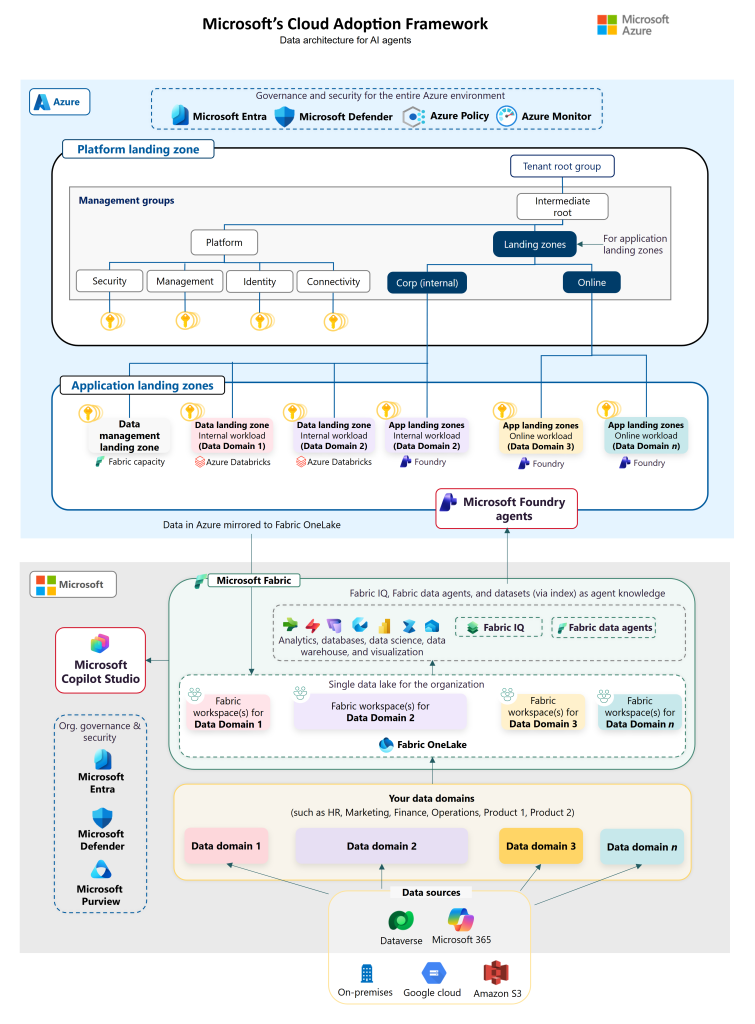
At DevOps Masterminds, we treat AI agents as real infrastructure from day one. That means Terraform or Bicep modules for the surrounding platform. Compute, networking, private endpoints, data connections, identities. All defined as code. Agents deployed through pipelines in Azure DevOps or GitHub Actions. Every change reviewed. Every version traceable. Dev, Test, Prod identical by design. And all of this enforced with guardrails using Azure Policy and managed identities.
This guarantees there are no shared secrets, no ad hoc permissions and no silent drift.
Even where native IaC support is still evolving, the platform and agent configuration can and should be automated and version-controlled. While some agent controls aren’t yet first-class declarative resources, prompts, model settings and tool bindings belong in source control and should be deployed through CI/CD just like the rest of your application.
And because an AI agent is only as good as the data it can safely reach, we often bring in our Data Masterminds colleagues early to make sure the data layer is just as reliable and governed as the infrastructure.
How to get started
Map your agent setup against the CAF phases and be honest about what’s missing. Define the full infrastructure in code instead of relying on portal clicks. Push deployments through pipelines so changes are versioned and reviewed. Add Azure Policy and managed identities to make secure-by-default the baseline, not an afterthought.
There’s no one-size-fits-all approach to the cloud. That’s why we meet you where you are.
If you want to bring structure, automation, and governance to your AI agents without slowing delivery, schedule a platform assessment with us today.